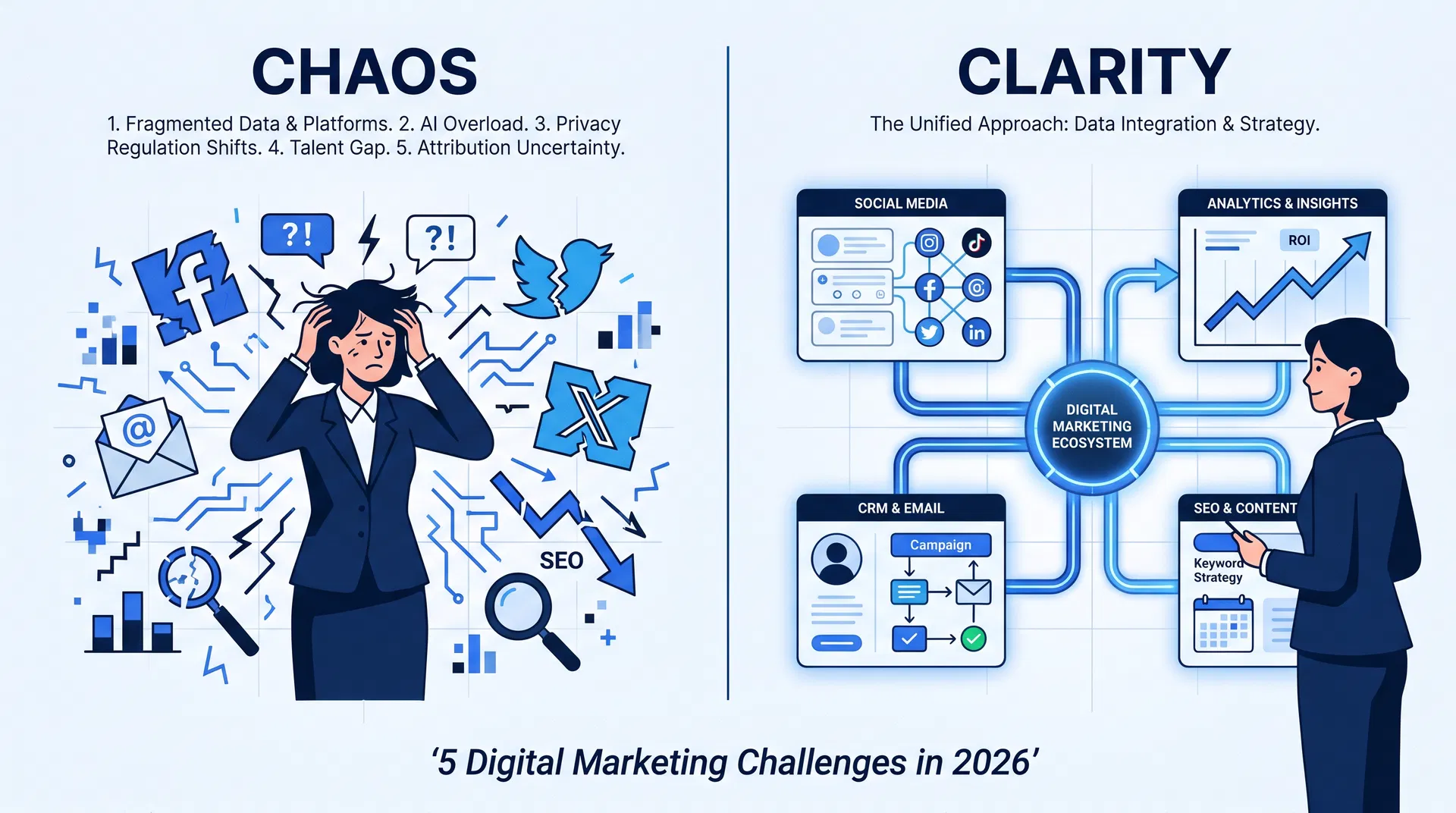
Digital marketing in 2026 is not harder because the fundamentals changed. It is harder because the environment around those fundamentals changed faster than most teams could adapt. AI-generated content flooded every channel. Privacy regulations reshaped data collection. Attention fragmented across more surfaces than ever. The teams that are winning are not the ones with the biggest budgets - they are the ones who identified the real friction points and built systems to address them.
This article breaks down the five challenges that are creating the most drag for marketing teams right now, and what the practical response to each one looks like.
73%
Marketers report data fragmentation
as their top operational challenge in 2026
4.1x
More content published per day
than in 2020 across tracked industries
61%
Of organic clicks now go to AI answers
for informational queries on Google
Challenge 1 - Fragmented Data Across Too Many Platforms
The average marketing team in 2026 uses between 12 and 16 tools. Analytics lives in one place, CRM data in another, ad performance in a third, and SEO metrics in a fourth. When these systems do not talk to each other, every strategic decision requires manual data assembly, and by the time the picture is complete, the moment to act has often passed.
The fragmentation problem is not just a workflow inconvenience. It creates systematic blind spots. A content piece that drives strong top-of-funnel awareness but weak direct conversions will look like a failure in a last-touch attribution model, even if it is doing critical work in the buyer journey. Without connected data, you cannot see the full picture.
Fragmented State
- ✕12+ disconnected tools with no shared data layer
- ✕Manual weekly exports to build reports
- ✕Different teams using different metrics for the same goals
- ✕Attribution gaps create false negatives on content ROI
- ✕Decisions made on incomplete or stale data
Unified State
- Single source of truth for cross-channel performance
- Automated reporting with real-time data
- Shared KPI definitions across teams
- Multi-touch attribution reveals true content value
- Decisions made on current, complete data
Challenge 2 - Content Volume vs. Content Quality
AI writing tools made it trivially easy to produce large volumes of content. The result is that every niche is now saturated with competent, generic articles that cover the same ground in slightly different words. Search engines are getting better at identifying this pattern, and readers are getting faster at recognizing it.
The challenge for marketing teams is not producing more content - it is producing content that has a genuine reason to exist. That means original research, specific expertise, or a perspective that is not already available in the top ten results for a given query. This is harder than it sounds when you are under pressure to maintain publishing velocity.
The practical response is a content triage system. Not every topic needs a long-form piece. Some queries are better served by a concise, direct answer. Others require depth, data, and expert input. Matching content format to query intent - and being honest about which topics you have genuine expertise in - is more valuable than publishing on a fixed schedule.
Our guide on running a content audit in 90 minutes walks through exactly how to identify which existing content is worth investing in and which is creating drag on your domain authority.
Challenge 3 - Organic Search Disruption from AI Overviews
Google's AI Overviews are changing the economics of organic search in ways that most teams have not fully accounted for. Impressions are up. Clicks are down. CTR is declining on informational queries even when rankings hold steady. The traffic model that justified content investment for the past decade is being restructured.
This does not mean SEO is dead - it means the goal of SEO is shifting. For informational content, the new goal is citation in AI Overviews rather than click-through. For commercial content, traditional ranking and click signals still apply. The teams that are adapting well are the ones that have segmented their content strategy by query intent and set different success metrics for each segment.
Understanding how AI Overviews are affecting zero-click rates is now a prerequisite for setting realistic organic traffic expectations and making the right content investment decisions.
Challenge 4 - Privacy Regulation and First-Party Data
Third-party cookies are effectively gone across most major browsers. Privacy regulations in the EU, UK, US states, and an increasing number of other jurisdictions have raised the cost and complexity of data collection. Retargeting audiences that were trivially easy to build in 2020 now require explicit consent flows, first-party data infrastructure, and in many cases, legal review.
| Data Type | 2020 Availability | 2026 Availability | Response |
|---|---|---|---|
| Third-party cookies | Universal | Effectively gone | Build first-party data |
| Cross-site tracking | Standard practice | Blocked by default | Contextual targeting |
| Email open rates | Reliable metric | Inflated by Apple MPP | Click-based engagement |
| Retargeting audiences | Easy to build | Requires consent | CRM-based audiences |
| Attribution data | Multi-touch available | Modeled/estimated | Incrementality testing |
The teams that are handling this best have invested in building owned audiences - email lists, community platforms, direct relationships - that do not depend on third-party data infrastructure. This is slower to build than retargeting audiences, but it is durable in a way that cookie-based targeting is not.
Challenge 5 - Proving ROI on Content and SEO Investment
Content marketing and SEO have always had a measurement problem. The results are real but the attribution is messy. A blog post that ranks for a high-intent keyword and drives 200 qualified visitors per month is genuinely valuable, but connecting that traffic to closed revenue in a CRM requires either a robust attribution setup or a willingness to use proxy metrics.
In 2026, this problem is compounded by the AI Overview effect. A page that is cited in AI Overviews may be building brand awareness and authority signals without generating measurable clicks. The value is real, but it does not show up in standard analytics reports. Teams that are not measuring brand impression volume and citation appearances alongside traffic and conversion data are systematically undervaluing their content investment.
The RankPilot features page covers how we approach this measurement problem - tracking ranking, citation, and content performance signals in one place so you can build a complete picture of organic channel ROI.
Define your measurement framework before you publish
Decide in advance what success looks like for each content type. Informational content: citation appearances, brand impressions, topical authority signals. Commercial content: traffic, leads, pipeline contribution. Using the same metrics for both creates systematic misattribution.
Use leading indicators alongside lagging ones
Traffic and revenue are lagging indicators - they reflect decisions made months ago. Ranking improvements, citation appearances, and engagement rates are leading indicators that tell you whether your current content investment is working before the revenue signal arrives.
Build a content attribution model that fits your sales cycle
A B2B company with a 90-day sales cycle needs a different attribution model than an e-commerce brand with a 3-day purchase window. First-touch, last-touch, and linear attribution all tell different stories. Choose the model that best reflects how your buyers actually make decisions.
Turn marketing complexity into competitive advantage.
RankPilot unifies your SEO research, content planning, and performance tracking so your team can move faster with less friction.
Start Free TrialKey Takeaways
- Data fragmentation is the root cause of most marketing efficiency problems - unified data is a competitive advantage, not just a nice-to-have.
- Content quality now matters more than content volume; AI-generated content without original expertise or data is increasingly a liability.
- AI Overviews are restructuring organic search economics - segment your strategy by query intent and set different success metrics for each segment.
- First-party data infrastructure is now a prerequisite for effective digital marketing, not an optional upgrade.
- Proving content ROI requires measuring brand impressions and citation appearances alongside traffic and conversion data.
Frequently Asked Questions