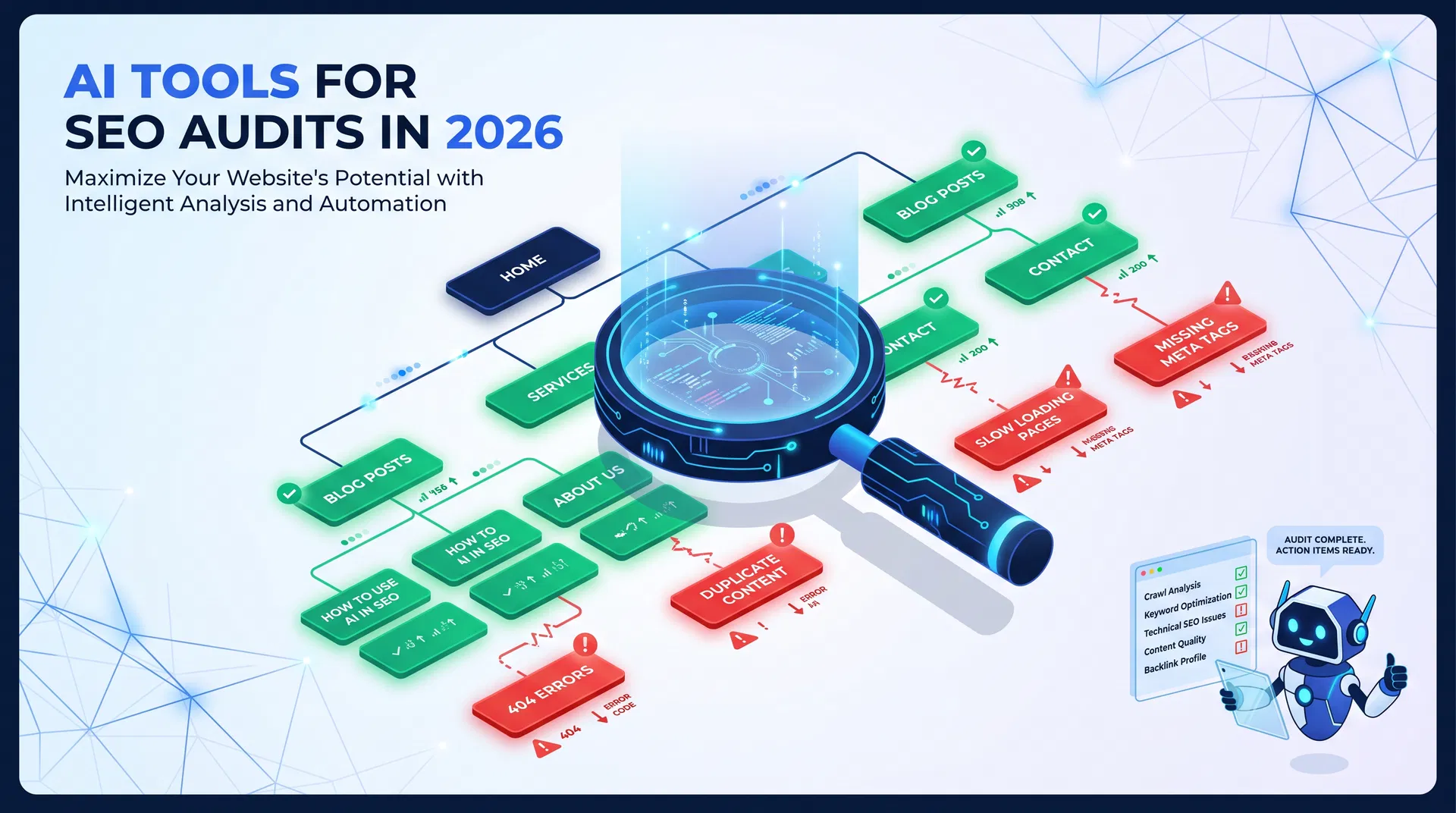
A thorough SEO audit used to take a week. You would crawl the site, export the data, manually review hundreds of rows in spreadsheets, cross-reference against Search Console, and then write up a prioritized action plan. In 2026, AI tools have compressed that timeline dramatically - but only if you know which tools to use for which part of the process, and how to avoid the common traps that turn AI-assisted audits into shallow checklists.
This guide covers the full audit workflow, the AI tools that are genuinely useful at each stage, and the parts of an audit where human judgment still cannot be replaced.
74%
Faster audit completion
with AI-assisted workflows vs. manual
3.2x
More issues identified
per audit hour with AI pattern recognition
89%
Of technical issues
can be detected automatically by AI crawlers
What a Complete SEO Audit Covers in 2026
Before choosing tools, it helps to be clear about what a complete audit actually covers. The scope has expanded significantly in the past two years, primarily because of two additions: AI Overview citation analysis and content quality scoring. A 2026 audit that only covers technical SEO and backlinks is missing the signals that are increasingly driving organic performance.
Technical Crawl and Site Health
AI role: Automatically categorizes issues by severity, identifies patterns across large sites, and prioritizes fixes by estimated traffic impact.
Content Quality and Topical Coverage
AI role: Scores content against top-ranking competitors, identifies topical gaps, and flags thin or duplicate content that is suppressing domain authority.
Keyword and Ranking Analysis
AI role: Clusters keywords by intent, identifies cannibalization, and surfaces quick-win opportunities where small content improvements could move rankings significantly.
AI Overview Citation Analysis
AI role: Identifies which pages are being cited in AI Overviews, which queries trigger citations, and what content structure changes could increase citation frequency.
Backlink Profile Review
AI role: Identifies toxic links, finds link building opportunities from competitor profiles, and flags anchor text patterns that may be triggering algorithmic penalties.
The Tools That Are Actually Worth Using
The AI SEO tool market has exploded in the past 18 months. Many tools make impressive claims that do not hold up in practice. The following breakdown focuses on tools that have demonstrated consistent, reliable results in real audit workflows - not tools that are impressive in demos but unreliable in production.
For Technical Audits
Screaming Frog with AI analysis: The gold standard for technical crawls. The 2025 and 2026 versions added AI-powered issue categorization that significantly reduces the time spent sorting through crawl data. It still requires a human to interpret the output and prioritize fixes, but the raw data collection and initial categorization are now largely automated.
Google Search Console: Still irreplaceable for understanding how Google actually sees your site. No third-party tool has access to the same data. Use it alongside crawl tools, not instead of them.
For Content Audits
Content audits are where AI tools have made the most dramatic difference. What previously required manually reviewing dozens of pages can now be done at scale. Our guide on completing a content audit in 90 minutes covers the specific workflow in detail, but the core principle is using AI to handle the data collection and initial scoring, then applying human judgment to the prioritization decisions.
“AI tools are excellent at identifying what is wrong. They are less reliable at telling you what to do about it. That judgment still requires someone who understands the business, the audience, and the competitive landscape.”
Common observation among experienced SEO practitioners
For AI Overview and GEO Analysis
This is the newest category and the one where tooling is still maturing. The core capability you need is the ability to systematically check which of your target queries are triggering AI Overviews, which pages are being cited, and what the citation frequency looks like over time. Understanding how generative engine optimization works is the prerequisite for using these tools effectively.
Where Human Judgment Still Cannot Be Replaced
AI tools are genuinely excellent at pattern recognition at scale. They can identify technical issues, flag content that is underperforming relative to competitors, and surface keyword opportunities that a human reviewer would miss. But there are several parts of an audit where AI output needs to be treated as a starting point, not a conclusion.
Business context and prioritization
An AI tool can tell you that 47 pages have thin content. It cannot tell you which 5 of those pages are worth investing in based on your business model, your sales cycle, and your competitive positioning. Prioritization requires business context that AI tools do not have.
Diagnosing the root cause of ranking drops
AI tools can identify correlations between changes and ranking movements. Diagnosing whether a drop was caused by a technical change, a content quality issue, a competitor improvement, or an algorithm update requires reasoning about multiple factors simultaneously in ways that current AI tools handle poorly.
Evaluating content quality for a specific audience
Automated content scoring tools measure topical coverage and keyword density. They cannot evaluate whether a piece of content is genuinely useful and trustworthy for the specific audience it is targeting. That judgment requires a human who understands the audience.
Building a Repeatable Audit Process
A one-time audit is useful. A repeatable audit process is a competitive advantage. The teams that are getting the most value from AI SEO tools are not running audits once a quarter - they have set up continuous monitoring that surfaces issues as they emerge, with periodic deep-dive audits to catch the patterns that continuous monitoring misses.
The RankPilot features are built around this model: continuous rank tracking and content monitoring with scheduled audit workflows that pull everything together into a prioritized action list. The goal is to make the audit process something that runs in the background, not something that requires a dedicated week of work every quarter.
Run your next SEO audit in a fraction of the time.
RankPilot combines crawl analysis, content scoring, rank tracking, and AI-powered recommendations in a single workflow.
Start Free TrialKey Takeaways
- A complete 2026 SEO audit covers technical health, content quality, keyword analysis, AI Overview citation analysis, and backlink profile.
- AI tools have compressed audit timelines by 74% on average, but primarily for data collection and pattern identification - not for interpretation and prioritization.
- AI Overview citation analysis is now a required component of any complete SEO audit; it is the fastest-growing source of organic visibility change.
- Human judgment is still essential for business context, root cause diagnosis, and audience-specific content quality evaluation.
- The highest-value audit setup is continuous monitoring with periodic deep-dive reviews, not quarterly one-time audits.
Frequently Asked Questions