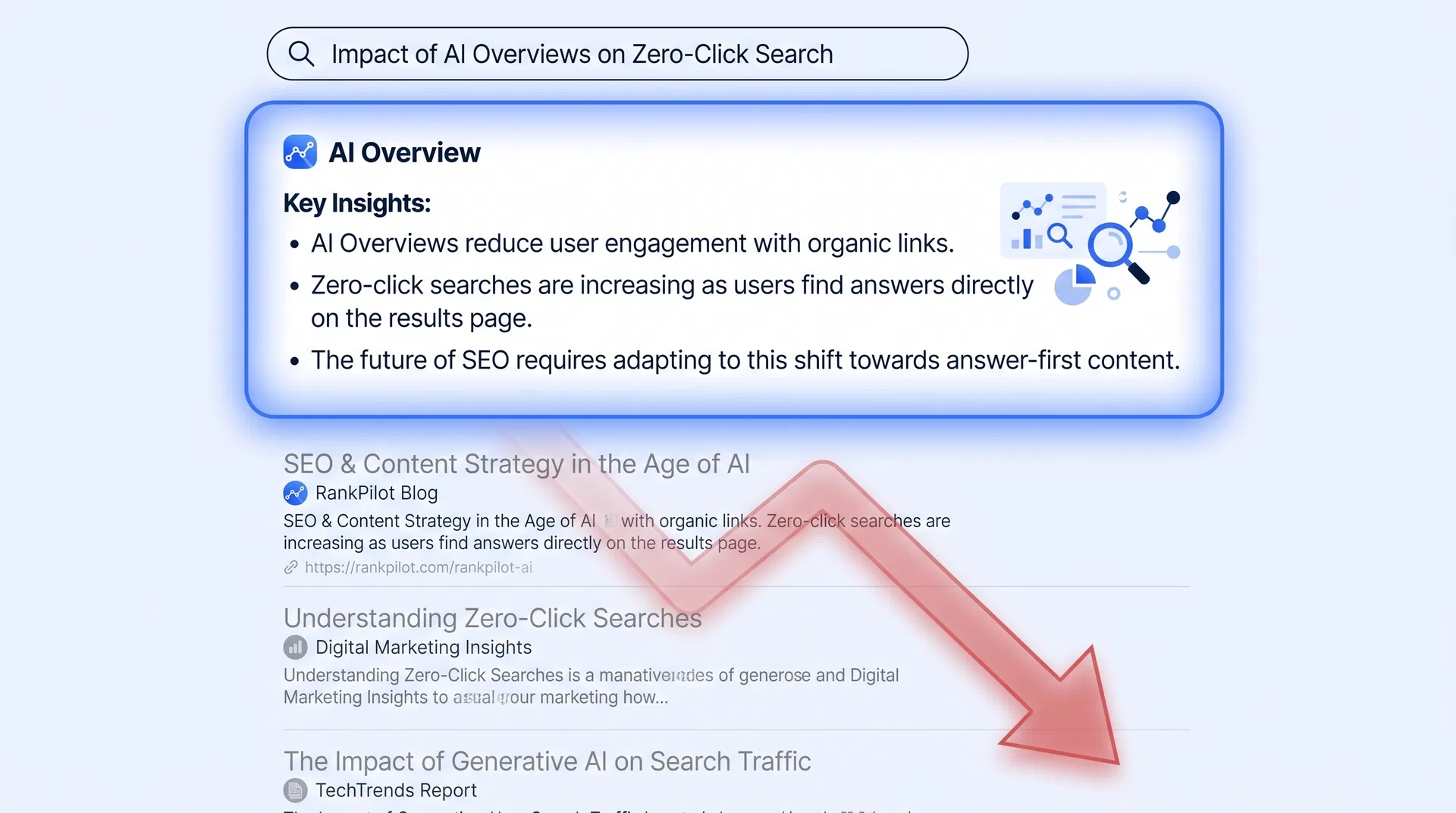
SEO dashboards are telling a strange story lately. Impressions are rising. Clicks are falling. CTR is trending down. Rankings often look stable or improved, yet organic traffic feels softer and performance questions start piling up.
This is not a tracking glitch. It is the zero-click reality, driven primarily by Google's AI Overviews. Understanding what is happening, why it is happening, and what you can do about it is now one of the most important things an SEO professional can focus on.
58.5%
Zero-click searches in 2025
up from 50.3% in 2022
-34%
Avg. CTR drop for AI Overview queries
vs. same queries without AIO
65%
Queries now triggering AI Overviews
across informational intent
What Are AI Overviews?
AI Overviews (formerly Search Generative Experience, or SGE) are Google's AI-generated summaries that appear at the top of search results for many informational queries. Instead of showing a list of ten blue links, Google synthesizes an answer directly in the SERP, pulling from multiple sources, citing a handful of them, and presenting the answer before the user ever clicks anything.
The result is a search experience where the user's question gets answered without them visiting your website. For a deeper look at how AI search engines decide what to include in these summaries, see our guide on Generative Engine Optimization and how AI Overviews use content.
Why Impressions Rise While Clicks Fall
This is the paradox that confuses most teams when they first encounter it. If you are ranking for a query that now triggers an AI Overview, Google Search Console will still record an impression every time that query is searched. But the user sees the AI-generated answer, gets what they need, and does not click through. The impression count stays the same or grows. The click count drops. CTR falls. Traffic softens. And your rankings report still looks fine.
“Ranking #1 used to mean traffic. Now it means you might be a source for an answer the user reads without ever visiting your site.”
Common observation among SEO practitioners in 2025-2026
Which Query Types Are Most Affected?
Not all queries are equally impacted. The effect is heavily concentrated in specific intent categories.
High Impact: Informational Queries
How-to guides, definitions, explanations, and factual questions. These are the queries most likely to trigger an AI Overview and least likely to generate a click even when they do rank.
Medium Impact: Comparison and Research Queries
Best-of lists, product comparisons, and research-stage queries. AI Overviews appear here but users are more likely to click through for deeper detail or to verify recommendations.
Low Impact: Transactional and Navigational Queries
Queries with commercial intent (buy, pricing, sign up) or brand-specific navigation are largely unaffected. Users searching to take action still click through.
The Citation Opportunity Inside the Problem
Being cited in an AI Overview is not worthless. While it does not generate the same click volume as a traditional #1 ranking, it builds brand visibility, signals authority to Google, and the clicks it does generate tend to be from users further along in their research who are more likely to convert.
How to Adapt Your SEO Strategy
Old Approach
- ✕Optimize every page for click-through rate
- ✕Measure success by organic traffic volume
- ✕Treat all query types the same
- ✕Ignore AI Overview appearances
- ✕Focus only on blue-link rankings
Adapted Approach
- Optimize informational content for citation, not just clicks
- Measure brand impressions and citation appearances alongside traffic
- Segment strategy by query intent type
- Track AI Overview presence as a KPI
- Build transactional content to capture high-intent traffic
Practical Steps to Take Right Now
Step 1 - Audit your traffic by intent type. Use Google Search Console to segment your queries into informational, commercial, and transactional buckets. Our guide on running a content audit in 90 minutes walks through exactly how to do this efficiently.
Step 2 - Check which pages are being cited. Search your target queries and look at the AI Overview source citations. Track this systematically using RankPilot's rank tracking and content monitoring features.
Step 3 - Restructure informational content for citation. AI Overviews favor content that is direct, structured, and authoritative. Add clear definitions at the top of articles, use structured headings that match common question formats, and include original data or statistics.
Step 4 - Shift investment toward transactional content. Review your use case pages and commercial content to make sure they are well-optimized and regularly updated, since these pages are largely unaffected by AI Overviews.
Step 5 - Redefine your success metrics. Add brand impression volume, AI Overview citation count, and conversion rate from organic to your reporting dashboard alongside traditional traffic and ranking data.
Stop guessing. Start optimizing for AI search.
RankPilot tracks your AI Overview appearances, monitors citation signals, and helps you structure content that gets cited, not just ranked.
Start Free TrialKey Takeaways
- AI Overviews are causing impressions to rise and clicks to fall — this is a structural shift in how search works, not a tracking error.
- Informational queries are most affected; transactional and navigational queries remain largely unaffected.
- Being cited in an AI Overview provides brand visibility and authority signals even when it does not generate clicks.
- Adapt by segmenting your content strategy by intent type and restructuring informational content for AI citation.
- Redefine success metrics to include brand impressions and citation volume alongside traditional traffic and ranking data.
- Shift investment toward transactional and commercial content that AI Overviews are less likely to replace.
Frequently Asked Questions